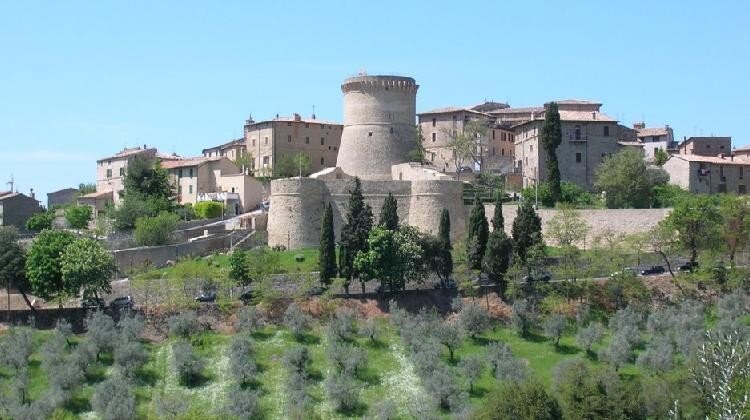
Located in the central part of Umbria, Gualdo Cattaneo is a medieval village perched on a hill at the foot of the Martani Mountains in a particularly picturesque position. In addition to the treasures kept within its ancient walls, it is also worth a visit for the system of castles and medieval buildings that characterize its territory: a true defensive complex that constitutes an extraordinary open-air museum. After the Castle of Gualdo Cattaneo, whose square is dominated by the Rocca, a fortress in the shape of an equilateral triangle with three towers connected to each other and by underground passages to the underlying castle walls, we find the Castle of Pozzo which, surrounded by olive trees, overlooks the Puglia valley. Its architectural layout and the particular medieval views it offers are remarkable. The Castle of Cisterna Alta, which rises on a hill above the Puglia river, dates back to the 13th century and today is in fair condition, with the tall medieval tower still clearly visible, next to which stands a residential core of nineteenth-century origin. On the border between the municipalities of Gualdo Cattaneo and Giano dell'Umbria, is the Castle of Marcellano, whose origins can be traced back to around the 12th century. It is famous for the living nativity scene organized every year during the Christmas holidays. The entire village is involved in the representation with settings and scenes of traditional medieval life, with dozens of costumed figures, artisan workshops showing ancient techniques, taverns with mulled wine and local gastronomic specialties. At sunset, in a unique setting, the Sacred Representation of the Nativity takes place. Of presumed Lombard origin is instead the Castle of Saragano (a few km from San Terenziano) which was the home of the Roman consul Lucio Lucinio Sura (from whom it perhaps took its name). The Castle of Ceralto can be considered a happy island out of time thanks to its unique location, immersed in the natural environment of oaks and Turkey oaks, to the original fusion between the site's layout and the architectural type, and the absolute peace that surrounds it. Near the castle grows one of the largest holm oaks in Umbria with an estimated age of around 200 years. In good condition is the Castle of Barattano, which perhaps represents the most marked archetype of the Gualdo castle system. A few kilometers from Gualdo, it is characterized by a structural morphology equipped with a large city wall with a medieval entrance gate, characteristic alleys and tall towers. Inside it preserves the church of S. Bartolomeo (13th century) with frescoes from the 16th and 17th centuries and two 16th-century wooden angels. From the top of an isolated hill, the Castle of Torri dominates the underlying valley crossed by the S.Terenziano - Bastardo road. An arched entrance gate, surmounted by the coat of arms of the Tuderte eagle, leads inside, where the houses are built against the perimeter walls. On the opposite side, we find the Castle of San Terenziano, built in the 14th century to defend the population. It was built according to a traditional square plan, using local stone. Inside is the church of S. Terenziano, a rare example of a building formed by two superimposed churches: the lower from the eleventh century and the upper built at the end of the 13th century. Completing the system of castles: the Castle of Grutti, halfway between Massa Martana and Todi, of whose medieval structure today some towers remain standing, the Castle of Speltara, on the S.Terenziano – Collazzone road, an abandoned square-plan manor with a single tall corner tower, the Castle of Simigni, near the hamlet of Bastardo, founded in 1103 and currently privately owned, the Castle of Forte Sorgnano and the Castle of Pomonte, whose structure is today surrounded by rich vegetation; with a quadrilateral plan, it has small towers at the corners.

ABOUT US
SOCIAL
CONTACT
LOCATION
Az. Agr. "Olio del Pozzo"
by Bacci Rolanda
VAT No. 02751090545
PEC: bacci.rolanda@pec.it
REA: PG-290284
Via Putuense 45
Gualdo Cattaneo
06035
Italy
Az. Agr. Bacci Rolanda © 2020 - "Olio del Pozzo" is a registered trademark under license - All rights reserved
Gualdo Cattaneo and its castles
Gualdo Cattaneo and its castles
2020-11-20 10:27
2020-11-20 10:27
Array() no author 93146
oliodop-umbria-bellaitalia-castelli-olioevo,